



Long-term gearbox oil performance on GE 1.5 platforms
Operational context
A total of 105 GE Energy 1.5 wind turbines were operated over an extended period.
The fleet was originally commissioned with factory-filled Castrol Optigear Synthetic A & X 320 gearbox oil.
Over time, recurring issues with water contamination and foaming began to affect oil condition. This led to reduced oil lifetime and increasing concern around long-term gearbox wear.
Instead of addressing individual events, attention shifted toward understanding how lubrication behaviour influenced overall drivetrain reliability.
Problem definition
Two recurring patterns were identified during operation.
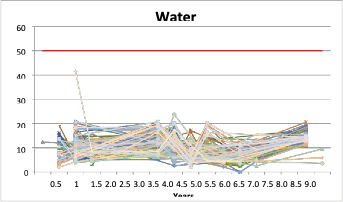
Water content in the gearbox oil increased over time.
Foaming was observed under operating conditions.
Both factors are known to accelerate wear, influence bearing fatigue life and reduce oil stability.
The objective was therefore not only to identify an alternative lubricant, but to validate its performance under real operating conditions over time.
Field testing approach
A three-year field test was initiated, comparing four different gearbox oils under identical operating conditions across selected turbines.
Evaluation focused on measurable field parameters, including contamination levels, wear indicators and oil stability.
Based on the results, the site transitioned to Amsoil PTN 320 gearbox oil, approved by both GE and the gearbox suppliers.
Long-term monitoring
Following the transition, oil analysis continued at six-month intervals over a total period of nine years, until the site was repowered.
Monitoring showed stable oil behaviour across the full observation period, including strong resistance to water contamination, controlled wear levels and limited foaming.
This extended timeframe made it possible to identify trends rather than relying on isolated samples.
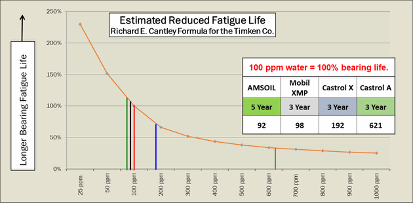
| Oil type | Average water level ppm | Delta to PTN | Lifetime compared to PTN | Average 4 µm particles | Delta to PTN |
| Amsoil PTN 320 | 92 | 100% | 100% | 668.978 | 100% |
| Mobilgear SHC XMP | 98 | 107% | 95% | 813.879 | 122% |
| Castrol Optigear X 320 | 192 | 209% | 68% | 1.256.980 | 188% |
| Castrol Optigear A 320 | 621 | 675% | 32% | 11.052.180 | 1652% |
Water content and bearing fatigue
Water contamination has a direct impact on bearing fatigue life.
Established models, such as the Cantley fatigue life model, illustrate how increasing water levels accelerate fatigue and reduce component lifetime.
Maintaining low and stable water content is therefore a key factor in preserving gearbox health over time.
Wear indicators over time
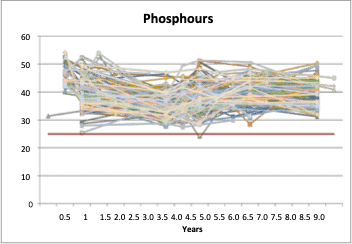
Phosphorus levels were monitored as an indicator of additive stability and wear behaviour.
Values remained stable throughout the monitoring period, supporting consistent lubrication performance under varying operating conditions.
Operational outcome
The site completed its remaining operational period without lubrication-related gearbox issues becoming a dominant factor.
Oil condition remained stable and predictable, allowing maintenance to be planned based on long-term trends rather than reactive interventions.
The project concluded with repowering, marking the end of a rare nine-year continuous field observation of gearbox oil performance.
Key observations
Long-term lubrication performance cannot be assessed through short test periods alone.
Water contamination and foaming are key drivers of gearbox wear over time.
Consistent field data collected over years reveals patterns that single measurements cannot.
Stable oil behaviour supports more predictable maintenance planning.
Closing
Long-term reliability is shaped by how systems perform under real conditions—not just how they perform in controlled tests.
When lubrication remains stable and resistant to contamination, it shifts from being a source of uncertainty to a contributing factor in drivetrain performance.
In practice, that means fewer disruptions, more predictable operation—and less energy lost over time.